


Table of Contents
- What You'll Need Before You Judge a Hoodie
- Fabric Weight and GSM: The First Quality Check
- Signs of Cheap Hoodie Construction to Watch For
- Screen Printing vs Digital Printing Hoodies: Which Lasts Longer?
- The Wash Test: How to Check Print Durability Before You Commit
- How to Care for Graphic Hoodies So They Keep Their Print
- Fit, Sizing, and Comfort: What High Quality Hoodies Should Feel Like
- Sustainability vs. Durability: Why They're Not the Same Thing
- Frequently Asked Questions
Last Updated: September 22, 2026
What You'll Need Before You Judge a Hoodie
Most people judge a hoodie by how it looks on the rack. That's the first mistake. Learning how to identify high quality graphic hoodies comes down to three things you can check in under a minute: fabric weight in GSM, stitch density at the seams, and how the print was applied. This guide walks through each one, plus a wash test.
- A phone light to inspect seam density and print edges
- The listed fabric weight (GSM) and material composition
- A close look at the interior stitching, not just the outside
- The print method: screen printing, DTG, or all-over print
Fabric Weight and GSM: The First Quality Check
GSM stands for grams per square meter, and it's the fastest way to judge fabric weight. But to identify a high quality graphic hoodie, you need to understand what GSM measures and what it hides.
Here's the practical range for graphic hoodies:
- 240-280 GSM: Lightweight summer hoodie. Breathable, drapes loosely, often used for promotional or festival pieces. Prints feel stiff because the ink sits on a thin substrate.
- 300-350 GSM: Midweight daily wear. The sweet spot for most graphic hoodies because it holds shape without overheating. A well-made 320 GSM loopback cotton is the benchmark for a three-season hoodie.
- 400-450 GSM: Heavyweight fleece. Blocks wind, holds structure, and gives prints a smooth, stable surface. This is where premium graphic hoodies usually live.
- 500+ GSM: Ultra-heavyweight. More armor than apparel. Great for cold climates and streetwear silhouettes, but slow to dry and restrictive in humid weather.
Why Two 400 GSM Hoodies Feel Different
Three construction choices change hand-feel at the same GSM:
- Loopback vs. brushed fleece. Loopback leaves interior loops exposed, so it breathes better. Brushed fleece is napped for softness but weakens the fiber surface and causes pilling. A 400 GSM loopback often outlasts a 400 GSM brushed fleece.
- Yarn twist. High-twist yarns are durable but firm; low-twist are softer but shed fibers faster. Premium hoodies use a medium twist.
- Knit structure. French terry, fleece, and interlock behave differently at the same weight. French terry is most common for graphic hoodies because it accepts ink well and resists shrinkage.
Material Composition and Colorfastness
Check two more things on the tag:
- Material composition: 100% cotton breathes well but can shrink 3-5% on a first hot wash. A cotton-polyester blend (80/20 or 50/50) resists shrinkage and pilling but feels less natural. Fleece lining adds warmth at the cost of breathability.
- Colorfastness: Ask whether the fabric is pre-shrunk and dyed for colorfastness. If the seller can't answer, that's a red flag. Home check: rub a damp white cloth on the fabric. If dye transfers, colorfastness is poor.
The GSM Trap: Why Higher Isn't Always Better
Higher GSM means more thermal retention and a denser hand-feel, but a 500 GSM hoodie in a humid climate feels like a coat indoors. Match the weight to how you'll wear it: for indoor or mild weather, 300-350 GSM beats 450+ GSM. The goal is a hoodie that holds shape and displays the print cleanly, not one that wins a weight contest.
Signs of Cheap Hoodie Construction to Watch For
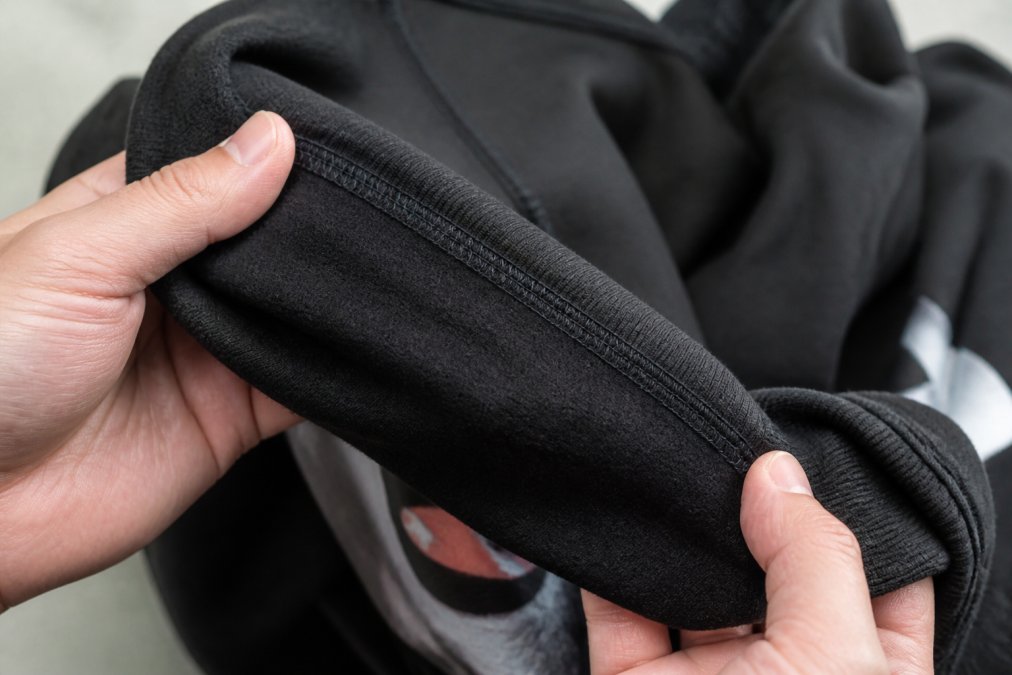
Cheap construction shows up in seams and hardware long before the print fails. Run your thumb along the inside shoulder seam. A well-built hoodie has a flat, covered seam; a cheap one has a raw edge that frays within a few washes.
Stitching, Seams, and Stitch Density
Stitch density is the number of stitches per inch, and it tells you how much stress a seam can take. Look for double-stitched seams at shoulders, armholes, and hem, single stitching at a high-stress point will split. Ribbed cuffs and hem should snap back when stretched, not stay stretched out.
Drawstrings, Cuffs, and Hardware
Drawstring quality is an easy tell: flimsy strings fray and pull through eyelets, while metal eyelets and aglets outlast plastic or heat-sealed ones. A zipper that pulls smoothly with no snagging suggests better hardware.
Screen Printing vs Digital Printing Hoodies: Which Lasts Longer?
The print method decides whether your graphic survives 50 washes or cracks at 10. Most guides mention screen printing and DTG but never explain how the ink bonds to fabric, the actual mechanism behind durability. Understand the bond, and you can predict longevity before you buy.
How Each Method Bonds to Fabric
Screen printing pushes thick, plastisol-based ink through a mesh stencil and cures it onto the fabric surface, forming a flexible film on top of the fibers. On heavyweight fleece, that film locks into the fabric's texture and resists cracking because ink and fabric move together. Trade-offs: best on lighter colors, can feel heavy on the chest, and needs a separate screen per color.
How to Identify the Print Method in the Store
You can usually tell which method was used in a few seconds:
- Screen print: Slightly raised texture, matte or semi-gloss finish, opaque solid colors. Stretch the fabric and the print stretches with it without showing the fabric underneath.
- DTG: Soft, slightly embedded, with sharp fine details and gradients. On dark garments you may see a faint white underbase at the edges.
- Sublimation: No texture at all, it looks like the fabric itself was dyed. Only on polyester or poly-blends.
- Embroidery: Raised thread, visible stitch pattern, backing material inside. Very durable but not for large graphics.
Durability Comparison
| Method | Durability | Best For | Weakness |
|---|---|---|---|
| Screen printing | High, holds colorfastness | Bold graphics, all-over print | Heavy feel, limited colors |
| DTG printing | Moderate | Fine detail, photos | Fades on blends |
| Sublimation | Very high on polyester | All-over print on poly | Won't work on cotton |
| Embroidery | Very high | Logos, small text | Not for large graphics |
| Applique | High | Textured designs | Bulkier feel |
The Fabric-Print Compatibility Rule
The most important rule: match the print method to the fabric.
- Screen printing works on almost any fabric, but performs best on 100% cotton or high-cotton blends with a smooth surface. On heavy fleece, it's the most reliable choice for large graphics.
- DTG requires 100% cotton for best results. On a 50/50 blend, expect faster fading and a duller finish; pretreatment helps adhesion but isn't a perfect fix.
- Sublimation requires polyester. On cotton, the dye won't bond and will wash out.
The Wash Test: How to Check Print Durability Before You Commit
The wash test predicts how a print will hold up: wash the hoodie inside out in cold water, then inspect for cracking, fading, and shrinkage before you decide to keep it. It won't match 50 real washes, but it surfaces weak prints fast.
- Turn the hoodie inside out and wash cold on a gentle cycle.
- Skip the dryer for the first test. Air dry flat.
- Check the print edges for cracking or lifting.
- Measure the length and chest before and after to catch shrinkage.
- Look for pilling on the fleece lining, a sign of low-grade fiber.
The Wash Test: How to Check Print Durability Before You Commit
Here's how to run it:
- Turn the hoodie inside out and wash cold on a gentle cycle.
- Skip the dryer for the first test. Air dry flat.
- Check the print edges for cracking or lifting.
- Measure the length and chest before and after to catch shrinkage.
- Look for pilling on the fleece lining, a sign of low-grade fiber.
A print that survives this with no cracking or fading is a good sign. One that lifts at the edges after a single wash will not last a season.
How to Care for Graphic Hoodies So They Keep Their Print
Caring for graphic hoodies comes down to three rules: wash cold, inside out, and never tumble dry on high heat. Heat cracks prints and shrinks cotton, so controlling temperature does most of the work.
Washing, Drying, and Storage Rules
- Wash: Cold water, gentle cycle, inside out. This protects the print from friction against other garments.
- Detergent: Use a mild detergent. Skip bleach and fabric softener, which break down ink and fleece fibers.
- Dry: Air dry flat or hang. If you must use a dryer, choose low heat and remove while slightly damp.
- Storage: Fold rather than hang heavy hoodies to avoid stretching the shoulders. Keep them out of direct sunlight to prevent fading.
Fit, Sizing, and Comfort: What High Quality Hoodies Should Feel Like
A high quality hoodie should feel substantial without being stiff and hold its shape after wearing. Fit is personal, but construction decides comfort.
Check these comfort markers:
- Breathability: A dense hoodie can still breathe if the fabric is knit well. Test by holding it against your face and breathing through it.
- Hand-feel: Soft, dry, and slightly dense is ideal. Slick or plasticky suggests heavy synthetic content.
- Ribbed cuffs and hem: They should grip gently and recover their shape.
- Lining: Fleece lining should feel brushed, not scratchy or thin.
Sustainability vs. Durability: Why They're Not the Same Thing
Dead Heat offers a curated selection of streetwear, electronics, and daily accessories designed for those who value style and utility. Our collection features trendy apparel, including unique hoodies and comfortable essentials, alongside a variety of lifestyle products. We are dedicated to providing high-quality items that keep you ahead of the curve in both fashion and function. Explore our latest arrivals and elevate your everyday look with our trending pieces. If you're tired of guessing whether a print will survive, start with the checklist above and check the garment, not the marketing.
Frequently Asked Questions
What fabric weight is best for a high-quality hoodie?
Aim for 350 to 450 GSM for heavyweight fleece that holds its shape and keeps prints stable. Anything under 280 GSM feels thin, pills faster, and tends to sag at the shoulders after a few washes. Midweight options around 300 to 350 GSM work well for layering, while 400 GSM and up suits colder weather and gives that structured, premium hand-feel most people associate with high quality hoodies.
How can you tell if a hoodie print will crack or fade?
Check the print technique first. Screen printing with plastisol or water-based inks sits on or in the fabric and survives dozens of washes; cheap DTG prints on dark colors often crack within 10 to 15 cycles. Run your thumb across the print: if it feels like a thick plastic sheet that lifts at the edges, expect cracking. A print that flexes with the fabric and returns to shape is a good sign.
Does stitching quality matter in graphic hoodies?
It matters more than most buyers realize. Look for double-stitched seams at the shoulders, armholes, and hem, plus a stitch density of 8 to 12 stitches per inch. Single-stitched seams pull apart at stress points, and loose or uneven stitching is one of the clearest signs of cheap hoodie construction. Check the inside of the garment, not just the outside, since hidden seams reveal the real build quality.
How should a premium graphic hoodie fit?
A well-made hoodie should sit close enough to keep warmth in without restricting movement. Shoulder seams should land on the edge of your shoulder, not droop past it. Sleeves should end at the wrist bone, and the hem should cover your waistband without riding up when you raise your arms. Oversized and relaxed cuts are fine as a style choice, but the proportions still need to be intentional rather than just cut large.
The hard part isn't finding a graphic hoodie. It's finding one that still looks sharp after a year of washes. Dead Heat curates streetwear built for that reality, with heavyweight fabrics, durable prints, and transparent pricing that includes duties and taxes. Browse the latest arrivals, join the email list for drop notifications, and get a hoodie that holds up as well as it looks.